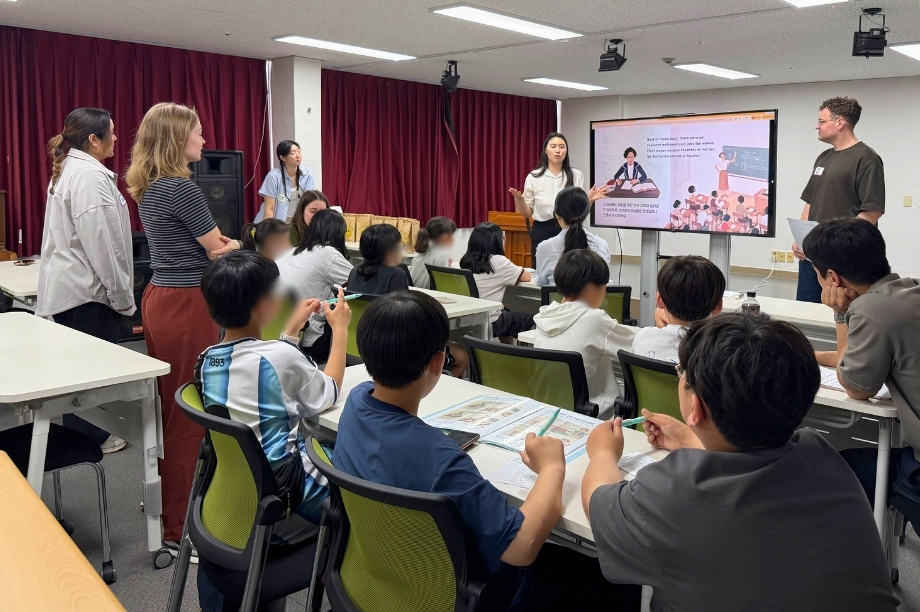
Minwoo is a third grader in South Korea. He’d been looking forward to his first official English class all year.
When his teacher asked the class simple questions, however, his classmates answered with ease. Many had studied English since they were four years old, through private after-school academies called hagwons. Minwoo never had that chance.
Within minutes, his excitement turned to quiet embarrassment. It was a feeling that followed him into math, reading, and nearly every subject where his classmates had a head start. A gap he’d never expected to feel on his first day back to school.
A Pattern That Repeats Every Year
Minwoo’s story is a composite, drawn from real interviews and our own experience with students across KKOOM’s partner children’s homes. However, the pattern itself is real.
In South Korea, formal English instruction doesn’t start until third grade. However, many students start years earlier, through hagwons. Hagwons are private after-school academies in Korea where most students go for extra tutoring in subjects like math, English, and science. According to a Ministry of Education report, 47.6% of preschoolers in Korea participated in private education last year (The Korea Times, July 2025). The number of English academies for young learners has nearly doubled since 2017.
In Seoul, English kindergartens can cost as much as $1,000 USD a month, a huge factor widening the education gap between those who have and those who have not. According to the Korea Herald, the average monthly fee for a half-day English academy rose from 1.31 million won (~$950 USD) in 2023 to 1.36 million won (~$985 USD) in 2024. For comparison, the average monthly salary in Korea in 2024 was 3.2 million won or roughly $2,319 USD (Korea Herald, June 2026).
Nationwide, families spent nearly $20.2 billion on private education in 2024, a 60% increase over the past decade (Korea Herald, Jan. 2026). For children without family resources behind them, the starting line keeps moving further away.

More Than Academics
The gap isn’t just academic. Students without hagwon access often report feeling socially isolated and anxious comparing themselves to better-resourced peers. We’ve seen it firsthand. At a STEM camp we held a few years ago, several elementary students told us that college and studying abroad simply felt “not for someone like them.” Between the cost of education and circumstances, the bridge to higher education can feel impossible to cross. For many of the students KKOOM supports, that sense of not belonging can shape their goals just as much as their grades.

Your Gift in Action
That’s why YOU make KKOOM’s Hagwon Scholarship Program possible, giving kids a real shot at a strong back-to-school season. Your gift gives a child in our care the same after-school academic support their peers take for granted: tutoring that typically costs $200–$300 USD a month per subject. With your support, students like Minwoo get to start school on equal footing: building confidence, keeping pace with their class, and believing their dreams are still within reach.
While the Korean school year officially starts in March, most students are now on break with a whole semester ahead of them come August and September. KKOOM will make sure the youth we work with head back to school with confidence, excitement, and a readiness to learn.
Thank you for investing in a future where every child’s perseverance and efforts, not their circumstances, determine how far they go.